 TAU Canada Multiple Sclerosis Fund
 The Steinhardt Museum of Natural History
 The Allies Fund at Tel Aviv University
Nurturing Hope
Interview with TAU Alumnus, Dr. Ofir Levi, Head of the Clinic at TAU’s National Center for Traumatic Stress & Resilience, about the sense of mission and therapy available to all.
Dr. Ofir heads a clinic for traumatic stress sufferers who believe in their own ability to resume their normal way of life and can benefit from focused short-term therapy. The clinic employs expert trauma therapists and conducts academic research. Individuals who have been exposed to distressing events or experienced emotional disruptions will be received immediately.
Editor and interviewer: Eilat Elgur Gurfinkel, Alumna of Journalism Studies at TAU
Translator: Michal Alexander
Career & Mission at TAU
Since January 1, 2024 – Head of the Clinic at the National Center for Traumatic Stress & Resilience
Since 2011 – Founding Academic Director of the 3-year Program for Psychodynamic Psychotherapy at the Continuing Education Unit of the School of Social Work, and Chief Editor of BetweenUs – the Program’s psychodynamic psychotherapy journal, published by the Hebrew Psychology website
Since 2007 – Lecturer at the School of Social Work
Center for Traumatic Stress & Resilience
The effort to establish the National Center for Traumatic Stress & Resilience was initiated in 2009 by Prof. Yair Bar-Haim from TAU’s Schools of Psychology and Neuroscience. The Clinic is one of the Center’s four divisions, which also include Research, Training, and Policy. The Clinic was launched urgently in October 2023 in response to the events of October 7, receiving its first patients on January 1, 2024. The Center’s dedicated building is under construction on the TAU campus, with its opening scheduled for 2026. Clinics for trauma therapy operate in health services, hospitals. mental health facilities, and private centers throughout Israel, and trauma centers for students were recently established in academic institutions.
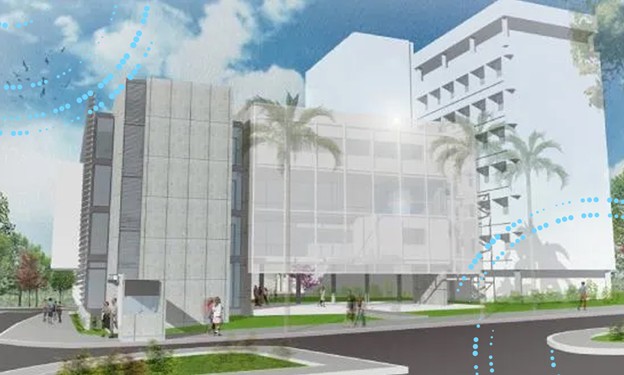
The Miriam & Moshe Shuster National Center for Traumatic Stress and Resilience at Tel Aviv University. Rendering: Erez Shani Architects, Engineering & Maintenance Division. Under construction.
“Clinics for trauma therapy operate in health services, hospitals. mental health facilities, and private centers throughout Israel, and trauma centers for students were recently established in academic institutions.”
How did you come to choose a career in social work and psychotherapy? Why did you decide to focus on PTSD?
After completing my mandatory service, I studied in a preparatory program at the Hebrew University. We were visited by representatives of various disciplines, including social work, and I realized I wanted to treat people as a profession. After graduating with a BSW, I saw a recruitment ad looking for mental health officers. This led to a 25-year career, 21 years as a Mental Health Officer and then as Commander of the PTSD Therapy Unit. Based on my experience, I wrote my MSW and PhD theses on PTSD.
In 2007, I began to teach at TAU’s School of Social Work, at first as a volunteer. In 2015, together with the late Dr. Hezi Cohen, we established the 3-year ‘Program for Training Supervisors in Psychodynamic Psychotherapy’ at the Continuing Studies Program of the School of Social Work. I am also Chief Editor of the Program’s academic journal, BetweenUs, which publishes studies and clinical cases.
How was the launch of the Center and Clinic affected by the events of October 7?
A few years earlier, TAU decided to establish the National Center for Traumatic Stress and Resilience with a PTSD Clinic, with the support of donors around the world. The opening was scheduled for 2026, upon completion of construction of the Center’s home – the Miriam and Moshe Shuster building. The Center includes four divisions: the Clinic, Research, Training, and Policy for National Impact. The Head of the Center, Prof. Yair Bar-Haim, asked me to head the Clinic, and I was happy to accept.
After October 7, I was called up for mandatory duty. I realized that the things we had talked about were happening right here and now. I told Prof. Bar-Haim that the Clinic couldn’t wait for the building to be finished. It had to be established immediately. TAU President Prof. Ariel Porat gave us the go-ahead, and on Oct. 20, 2023, the steering committee, made up mostly of professors from the Schools of Psychology, Social Work and Neuroscience, met for the first time. On January 1, 2024, the Clinic opened its doors. Specializing in treatment for all types of PTSD, it includes about 30 professional therapists with 15-35 years of experience in clinical therapy and research.
How was the Clinic established in such a short time? In what ways does the Clinic implement your vision?
The clinic was launched thanks to support from TAU President. Prof. Bar-Haim and I called various professionals and retirees like me, and they came. The team’s clinical experience and research expertise are extremely important.
Many resilience centers have been established in Israel, but there aren’t enough therapists specially trained to treat PTSD, with its specific nuances.
Trauma therapists become experts only when they’ve accumulated experience. As part of our vision, we are opening a training program for psychologists, social workers and psychiatrists who already work with trauma victims. Sixteen professionals have signed up, and the program will be launched on October 30, 2026.
We also conduct research by testing our therapeutic methods and their effectiveness at the Clinic. For example, we compare cognitive therapy with trauma-focused dynamic psychotherapy, or individual dynamic psychotherapy with group therapy, and so on. We chose methods that have been proven effective for PTSD, but we still test ourselves by methodically collecting data and checking whether our patients show improvement, and whether this improvement is still evident in follow-up sessions.
What is the goal of trauma therapy? Restoring patients to their normal way of life or rehabilitation?
The main term we use is ‘maintaining sequences’. We distinguish between people who functioned normally before the event and those who didn’t. For those who did, the goal is to restore functionality around pre-trauma sequences. For example, if after an Iranian missile landed close by, a person is unable to function or go to work for a week or two, we aim to gradually restore their functional sequences. However, if an individual did not function prior to the event, it is likely that the experience has further damaged their ability to function. In such cases, rehabilitation is required, which is much more complex.
You write about therapy as a journey shared by patient and therapist, emphasizing that hope is essential to the process. How does it work?
This is something I love to talk about. My PhD dissertation is about the meaning of hope for people with PTSD. The journey I talk about begins with distress. When people experience distress, they seek an expert and must feel intuitively that this expert is a human being who can help them and ease their suffering. That’s their initial hope. This is followed by a shared process in which both parties gain a better understanding of the patient’s anguish, and hope is enhanced through the therapeutic relationship formed between them.
What can you tell us about your experiences as a PhD student at TAU?
I am happy to answer this question. My experiences at TAU were amazing, and of course it all began with a personal relationship. I submitted a research proposal on the topic of hope to Prof. emerita Riki Savaya, and she became my supervisor. But three weeks before the proposal’s approval, I asked to change the research methodology to the qualitative-phenomenological method, based on in-depth interviews with chronic PTSD sufferers (unrelated to drug addiction, which appeared in the initial proposal). Prof. Savaya and TAU consented to the change, and Prof. Ronit Leichtentritt joined the study as co-supervisor. So, I had two very knowledgeable, patient, and humane supervisors.
In fact, I work at TAU thanks to Prof. Savaya, who allowed me to start teaching as a volunteer in 2007, paving my way to a position at the School of Social Work. I had a wonderful experience. I absolutely love the School of Social Work and feel part of it. I work many hours, and love TAU.
What is your message to TAU alumni?
If anyone around you has been exposed to a traumatic event, and you sense a change in their behavior or emotions, advise them to seek assessment. It is important to overcome any shame they might feel. We receive everyone at our clinic. An assessment won’t necessarily lead to therapy but will ensure peace of mind for all concerned, just like a medical test.
Unlike other high-quality clinics, we have no waiting list and receive everyone immediately. Make use of our availability! This is made possible by how we work – focusing on effective therapies, assessing each patient’s condition very carefully, and offering every patient a method that’s right for them. As a result, patients usually require no more than four to five months of trauma-focused therapy. The minimum is three months. Thus, the entire process consists of 12-22 weekly sessions held at a fixed time on a fixed day of the week, at an affordable price of just 120 NIS per session.
“If anyone around you has been exposed to a traumatic event, and you sense a change in their behavior or emotions, advise them to seek assessment. It is important to overcome any shame they might feel. We receive everyone at our clinic.”
Clinic of the National Center for Traumatic Stress & Resilience at Tel Aviv University
Phone: 03-6406900; Cellular: 050-2874955
Email: hosen@tauex.tau.ac.il