 TAU Canada Multiple Sclerosis Fund
 The Steinhardt Museum of Natural History
 The Allies Fund at Tel Aviv University
Israel’s First India Chair Established at TAU During Ambassadorial Visit
Indian Ambassador J.P. Singh meets students and leadership and signs landmark cooperation agreement
During the visit, Ambassador J.P. Singh met with Indian students and researchers from across the university and held discussions with Tel Aviv University leadership. The visit culminated in the signing of an agreement to establish Israel’s first India Chair at TAU.
At the outset of his visit, Ambassador Singh expressed condolences following a recent terrorist attack in Australia and underscored the close relationship between India and Israel.
“Whenever there is a crisis, India and Israel stand together,” he said, adding that his visit marked an important event focused on strengthening academic cooperation.
Strategic Dialogue with University Leadership
Ambassador Singh met with Tel Aviv University President Prof. Ariel Porat, Vice President International Prof. Milette Shamir, Director of Asia Engagement Konstantin Platonov, and senior faculty representatives to discuss the university’s long-term academic engagement with India.
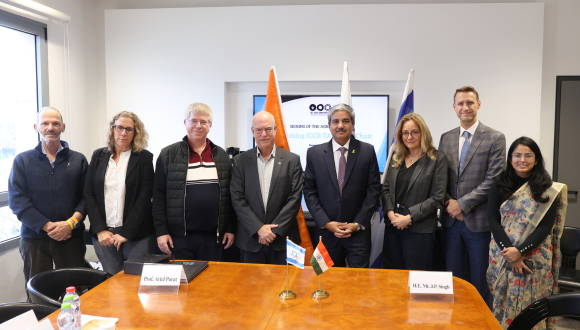
Left to right: Prof Nir Ohad, Vice Dean of the Faculty of Life Sciences; Prof Liora Sarfati, TAU Department of East Asian Studies; Prof. Noam Eliaz, Dean of the Faculty of Engineering; TAU President Prof. Ariel Porat; Ambassador J.P. Singh; Vice President International Prof. Milette Shamir; Director of Asia Engagement Konstantin Platonov, Sayali Narayan Mhetre, Director of the Indian Cultural Center in Israel (Photo credit: Chen Galili)
Welcoming the ambassador, Prof. Porat emphasized the strategic importance of India in TAU’s international outlook:
“Our ties with India are very important to us. I have been in India both as president and previously as a law professor, and I have seen firsthand the quality and potential of academic collaboration.”—Tel Aviv University President Prof. Porat
During the discussions, Prof. Porat proposed the establishment of a new Forum on Innovation and Education, envisioned as a platform for direct dialogue and collaboration between leading universities in Israel and India. The proposal received immediate support from Ambassador J.P. Singh.
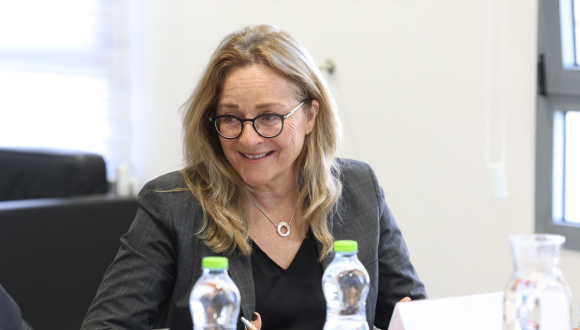
TAU VP for International Affairs Prof. Milette Shamir during the meeting with the Ambassador of India to Israel. (Photo credit: Chen Galili)
Framing TAU’s broader vision, Prof. Shamir described the relationship as a two-way academic bridge:
“TAU’s mission is to serve as a gateway to Israeli science and academic expertise for Indian academic partners, and as a gateway to India for Israeli researchers and students in terms of cultural exchange and beyond,”—Vice President International Prof. Milette Shamir
She noted that TAU’s collaboration with India extends well beyond formal agreements. Over the past decade, TAU researchers have produced more than 1,000 joint publications with Indian colleagues, providing a strong foundation for expanded cooperation, including joint PhD and master’s programs and increased faculty mobility.
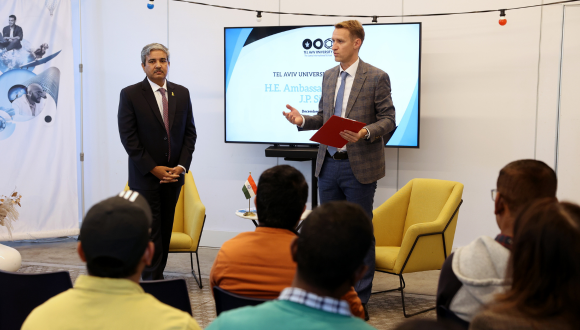
H.E. Mr. J.P. Singh, Ambassador of India to Israel, with Konstantin Platonov during a meeting with members of the Indian student community at Tel Aviv University. (Photo credit: Chen Galili)
Highlighting the campus dimension, Platonov pointed to the strength of the Indian research community at TAU.
“Indian research students are the second-largest cohort of foreign students at TAU and a thriving community. They feel comfortable and safe on our campus and build strong connections with our professors.”—Director of Asia Engagement Konstantin Platonov
From the faculty perspective, Prof. Nir Ohad, Vice Dean of the Faculty of Life Sciences and head of food security studies at TAU, focused on the long-term impact of sustained academic exchange.
“Our joint master’s program with Thapar University has created a clear pipeline of academic training. Students progress from graduate studies at TAU to PhDs, postdoctoral research, and faculty positions in India.”—Prof. Nir Ohad, Vice Dean of the Faculty of Life Sciences
Representing the engineering faculty, Prof. Noam Eliaz, Dean of the Faculty of Engineering, stressed that all graduate-level engineering programs at TAU are taught entirely in English, making them accessible to international scholars from India pursuing master’s, PhD, and postdoctoral training.
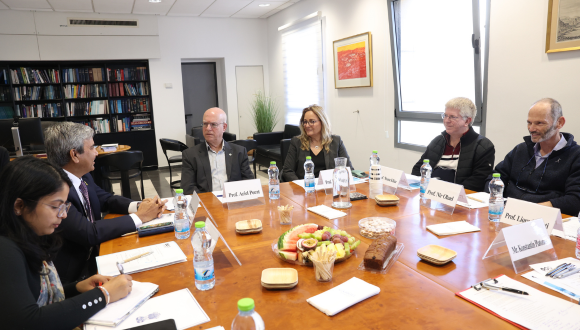
H.E. Mr. J.P. Singh, Ambassador of India to Israel, discusses academic cooperation with Tel Aviv University leadership and faculty members. (Photo credit: Chen Galili)
In the humanities, Prof. Liora Sarfati from the Department of East Asian Studies spoke about TAU’s contribution to education and cultural scholarship, citing the Faculty of Humanities’ extensive experience in education studies. She also noted that TAU is home to one of the world’s largest Sanskrit programs, whose graduates continue into advanced research and academic careers in Israel and abroad.
Ambassador J.P. Singh welcomed TAU’s multidimensional engagement with India and underscored the urgency of expanding academic cooperation.
“This is the right time to deepen collaboration in education through student and faculty exchange, joint research, and partnerships between universities, public and private.”—Ambassador J.P. Singh
Establishing the ICCR–TAU India Chair
A central highlight of the visit was the signing of an agreement establishing the ICCR–TAU India Chair, in cooperation with the Indian Council for Cultural Relations (ICCR).
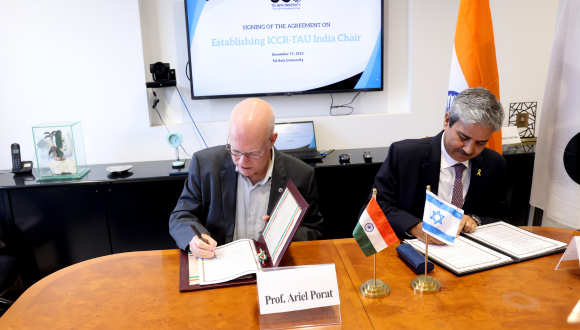
TAU President Prof. Porat and Ambassador J.P. Singh sign the ICCR–TAU agreement establishing the ICCR–TAU India Chair. (Photo credit: Chen Galili)
The first initiative of its kind in Israel, the ICCR-TAU India Chair will enable TAU to host leading Indian scholars annually across a range of academic fields, made possible through generous sponsorship from ICCR.
“This chair will allow scholars of India to engage with Tel Aviv University on a regular basis.”—Ambassador J.P. Singh
“By inaugurating the ICCR–TAU India Chair at TAU and establishing the TAU India Hub in Delhi for permanent in-country representation, we are taking our engagement with Indian students, research partners, and other stakeholders to the next level,” commented Platonov.
Meeting India’s Research Community at TAU
During his visit, Ambassador Singh also met with Indian students and postdoctoral researchers at TAU, representing disciplines including medicine, chemistry, life sciences, mechanical engineering, materials science, and plant sciences.
The meeting reflected the diversity of India’s academic presence on campus, with students originating from different regions across the country. “India is very well represented here,” said the ambassador.
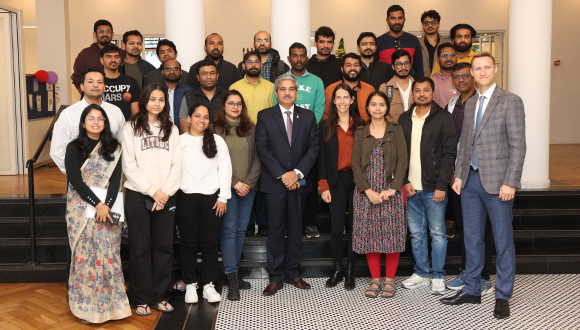
Ambassador J.P. Singh (in the center) with Maureen Meyer Adiri, the Director of the Lowy International School, and Konstantin Platonov, Director of Asia Engagement (on the right). (Photo credit: Chen Galili)
He encouraged students to remain focused on their academic goals while making the most of their international experience: “You have come here for studies. When you achieve something, you will contribute to the development of India.”
At the same time, Ambassador J.P. Singh emphasized their broader role:
“You are our ambassadors. Through your daily interactions, your research, and your engagement with Israeli society, you help bring our two countries closer together.”
During the discussion, students highlighted the potential to build on Israel’s startup and innovation experience to help advance India’s growing startup ecosystem, pointing to potential collaboration between academia, industry, and entrepreneurs in both countries.
Future Directions in India–Israel Cooperation
The visit reflected a shared vision for the future of India–Israel academic cooperation, with education positioned as a key driver of innovation, cultural understanding, and long-term partnership.
Echoing Ambassador Singh’s remarks on expanding exchange programs, strengthening joint research, and exploring new models of institutional presence in India, Tel Aviv University continues to deepen its engagement through initiatives such as the ICCR–TAU India Chair and expanded research collaboration, reinforcing its role as a global hub for academic excellence and international exchange.